




| Who assesses?
Throughout the learning process, both students and teachers should be actively involved in assessing student progress. Student will regularly be asked to assess their own work and to reflect on their learning process.
Teachers will support students in assessing their own work by providing assessment criteria as phrased in performance lists or in rubrics should preferably be established in collaboration with the students and should preferably be established in collaboration with
The students and should guide both feedback sessions between the teacher and the student and student assessment. The assessment criteria should be accessible for the students while they are working towards a product.
When do we assess?
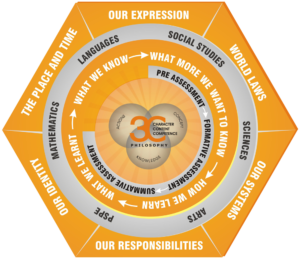
Pre-Assessment
At the beginning of each unit of inquiry, teachers will assess children’s prior knowledge and experience before embarking on new learning experiences.
Formative Assessment
Ongoing and regular assessment will be used during the teaching and learning process to inform teachers and children about how the learning is developing. Formative assessment and teaching are directly linked. A variety of methods will be used.
How do we assess?
Assessment Strategies:
Observations:
All children are observed informally, with the teacher taking notes on the individual, the group, and the whole class, Observations include how groups work and the roles of participants within the group.
Process focus: Students skills and developing understanding are observed in real contexts, wherever possible, using checklists, narrative notes. The emphasis is on the process and skill application rather than the product.
Open Ended tasks: Students are given a stimulus and asked to communicate an original response. No two students will have the same response. In this way the student’s understanding and application can be individually assessed.
Student Portfolios:
Teachers and students maintain a portfolio of work that demonstrates growth, thinking, creativity and reflection for both academic and social development overtime.
Recording Assessment Data:
All teachers at DRS Kids have a recording system. The recording system includes record sheets on which teachers are required to write narrative comments on student performance. The record sheets assist teachers to record development in the areas of conceptual understanding, skills and attitudes.
The reporting of the results of our assessments is holistic. Reporting focuses on process as well as product and relates the assessment results to both the curriculum and the learning contexts.
Reporting Assessment data:
When writing written reports and preparing for parent Teacher Conferences, teachers consult and use their recording system. In the written reports and in the parent Teacher conference specific reference will be made to student performance as evidenced in written work, discussion or behaviour. We report the findings of our assessment through:
Parent-Teacher Conferences
Parent teacher conferences will take place every year in the week before the October break. During the parent-Teacher conference, the teacher will describe how the student performs and behaves in the class and the parents will provide their perspective.
Portfolios
Portfolios are purposeful collections of student’s work. Throughout the year, students regularly look back at their work, select products that show progress and reflect on them. This assists the students in becoming self-assessors The teacher will offer advice regarding the selection of student products and some products may be selected by the teacher. The teacher will add descriptions of the context in which the student product was generated, an explanation of the task, the link to the curriculum as well as their own comments on the product. In addition, general reflections, Photographs illustrating processes and other evidence of student progress may be included. A selection of work in the student portfolio should be annotated with a student reflection saying what the work hoes and why it was chosen. all products in the portfolio should be dated. The student and teacher are responsible for regular additions to and revision of the portfolio.
The student portfolio should include self assessment, draft and final form exemplars, reflections and samples to show growth overtime.
Teachers will be responsible for monitoring student portfolio content, both for the teacher selected and student-selected entries.
Student-Led Conferences
The student-Led conference is a meeting in which the students use their portfolio as a basis for discussion with their parents about their learning. The conferences allow students to play an active role in the reporting process and communicate their progress to their parents. The teacher will usually not participate in the student-led conference. The teacher may be present as a facilitator, if necessary, but not as the reporting authority. At the end of the conference, the parent and the student may together fill in a form that describes strengths, goals and strategies. |